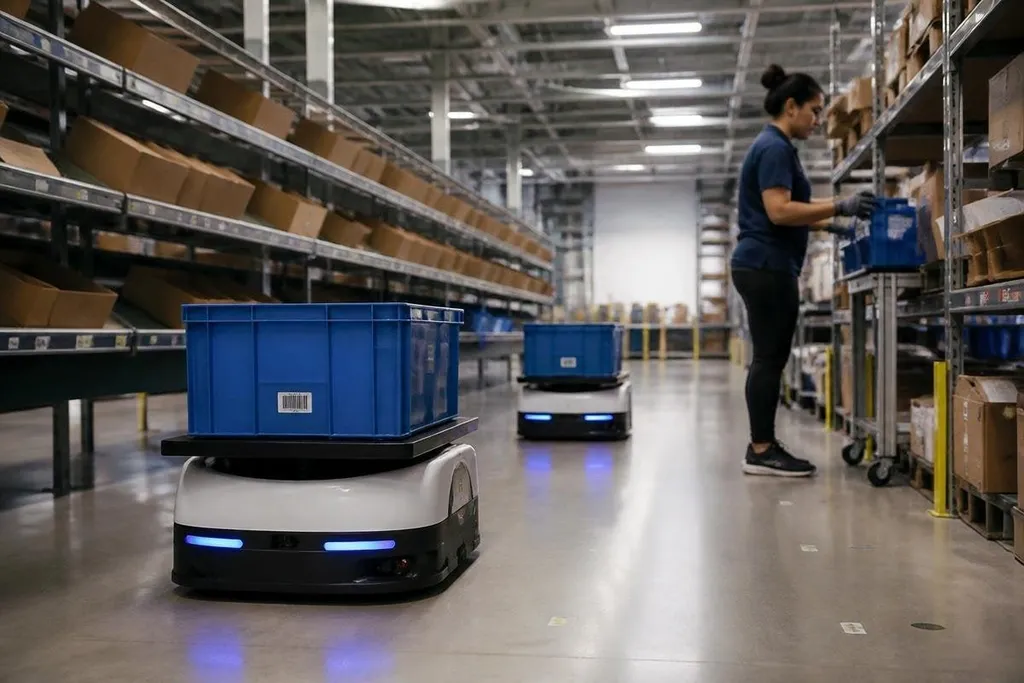
An e-commerce order can pass through several hands before it reaches a delivery box. Robots can carry storage bins, bring shelves to workers, sort parcels, and move finished orders toward packing, cutting the walking and waiting that slow busy warehouses.
The useful question is where a robot removes a delay, and where it only moves that delay somewhere else.
Quick read
- Mobile robots can bring shelves or bins to a picking station, so workers spend less time walking.
- Robotic arms can sort or pack repeatable items, but mixed products still need careful sensing.
- Faster movement helps only when software, stock records, packing space, and delivery cutoffs keep pace.
Where robots save time
Many warehouses lose time between tasks rather than during the pick itself. A worker may walk to a shelf, search for the right item, carry it back, then wait for an open packing station.
A mobile robot can carry the shelf or bin to the worker instead. That changes the worker's task from travel to picking. The robot still needs a map, route rules, battery charging, and a way to avoid people, shelves, and other vehicles. If any of those parts fail, the order waits beside the aisle rather than beside the packing bench.
Robotic arms fit a different part of the process. A vision system can locate an item, while the arm uses a gripper to lift it into a tote or shipping box. The setup works best when products have known sizes, stable packaging, and enough space between items for the gripper to reach.
Soft bags, clear plastic, tangled cables, and products pressed against one another make the task harder. A human can change their grip after seeing a problem. A robot needs suitable camera data, software rules, and a safe recovery step.
The software decides the pace
A warehouse robot is part of an order system, not a stand-alone worker. The warehouse management system must send the right task, record each item, and pass the order to packing without creating duplicate work.
Barcode scans and weight checks can confirm that the tote contains the intended product. Those checks matter because a fast pick with the wrong item still creates a second shipment, a return, and more work for customer service.
For a buyer comparing warehouse systems, warehouse robot deployment reports can put the maker, test site, and task behind each claim. A clip of one successful pick says little about traffic control across a full order flow.
The control software also needs to manage traffic. If several robots reach one narrow lift or packing lane together, the queue moves to that point. A good setup spreads tasks across available stations and sends work where people and equipment are ready.
Where the gains stop
Robot speed does not fix missing stock. A system can reach a shelf quickly, but the order still pauses if the item count in the database differs from the physical count.
Packing can become the next delay. More picking capacity may send more totes to a station than the packers can handle. The warehouse then needs enough benches, printers, boxes, labels, and trained staff to process the added flow.
Returns create another test. A robot built for regular outbound orders may need different rules for opened packaging, damaged goods, or items that need inspection. That work often stays with people because the decision depends on product condition.
Cost also extends beyond the robot. The buyer may need floor changes, network equipment, software work, safety checks, spare parts, and staff training. A lower robot count can still make sense if it removes the longest delay in the order path.
A practical buying check
Before choosing a system, check these points against one complete order:
- Find the slow step: measure walking, waiting, picking, packing, and handoffs separately.
- Test the product range: include soft packaging, small items, awkward shapes, and products with reflective surfaces.
- Check recovery work: ask who fixes a missed scan, dropped item, blocked route, or full battery queue.
- Trace the software link: confirm how orders, stock counts, scans, and exceptions move between systems.
- Price the full setup: include installation, floor changes, support, training, spare parts, and power use.
I'd choose the system that removes a measured delay in the current warehouse, even if it moves fewer items per hour on paper. The system earns its place when the complete order reaches the customer sooner, with fewer errors and fewer manual handoffs.
The next test is simple: run one order through the warehouse, record every pause, and see which pause the robot actually removes.